What It Actually Takes to Build an AI Personal Shopper Not Just Another Chatbot
Most Shopify chatbots answer questions. WisdomChat sells. Here's what it actually takes to build an AI personal shopper that converts browsers into buyers.


If your chatbot is just answering questions, you don't have a sales tool. You have a search bar with a friendly face.
I've seen this across dozens of Shopify fashion stores. Someone installs a chatbot, puts it live, and feels like they've ticked the AI box. But six months later, the conversion needle hasn't moved. The chatbot has answered thousands of questions about shipping timelines and return policies — and not sold a single kurta.
That's not a chatbot problem. That's a design problem.
Most chatbots are built to deflect support tickets, not to sell. And if you build something to answer questions, it will answer questions. Brilliantly. But it won’t do what a salesperson does — which is an entirely different job. WisdomChat is an AI personal shopper built for Shopify to bridge that gap — designed from the ground up to sell, not just support.
TL;DR
- Most Shopify chatbots are built for support, not sales — they are the wrong tool for conversion.
- Real selling requires reading the shopper's emotional state, detecting hesitation, and acting at the right moment.
- WisdomChat detects 8 shopper emotional states in real time and triggers context-aware conversations proactively.
- It personalises for anonymous visitors without a login, building preference profiles silently across sessions.
- Support and selling cannot share the same AI system — the goals are fundamentally different and require separate architecture.
What AI-Powered Selling on Shopify Actually Requires
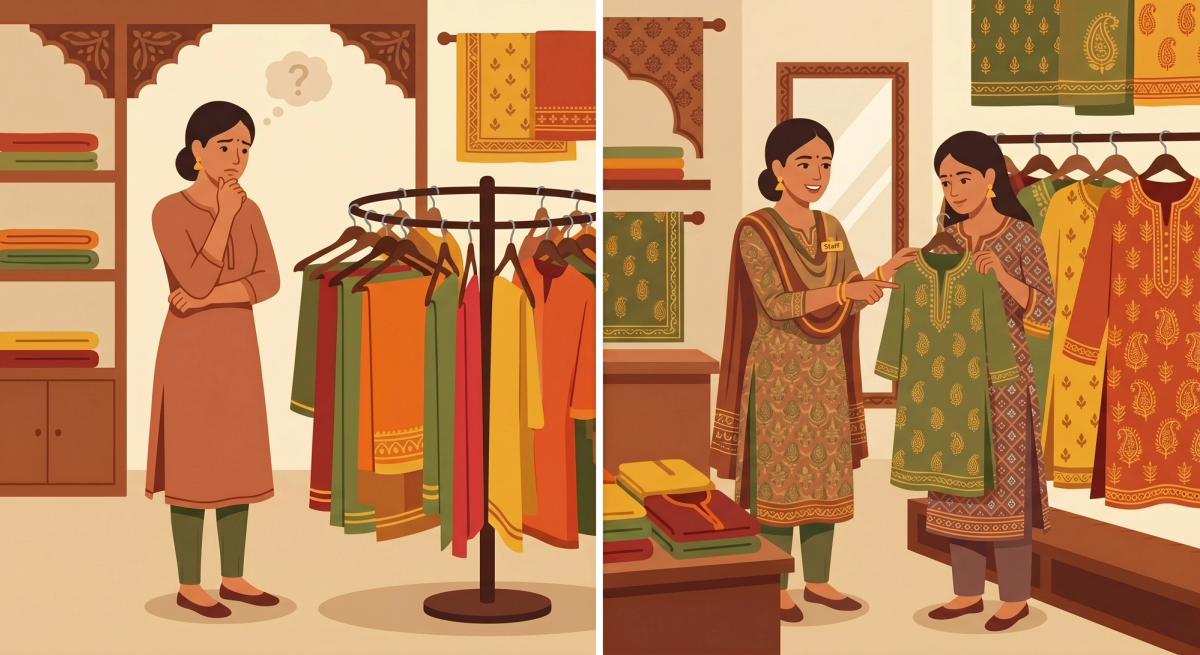
Think about the best salesperson you've ever worked with — or bought from. What made them good?
They didn't wait for you to ask. They noticed you lingering at the Banarasi silks for a beat too long. They could tell from the way you were checking the price tag whether you were hesitating on budget or just comparing options. They knew when to walk over and when to give you space. And when they did speak, they said something specific to you — not a script.
That is what selling requires. It requires reading the room.
WisdomChat detects 8 emotional states in real time — not from what the shopper says, but how they say it and what they're doing on the page. Excitement and confusion require completely different responses. So do urgency and anxiety. Treating them the same is what most chatbots do. It's also why most chatbots feel robotic even when they're technically accurate.
Beyond emotion, there's knowing where the shopper is in their decision. Someone browsing your collection page is in a different headspace than someone who has been staring at a product page for the last two minutes. Someone who just added something to their cart and then stopped is in a completely different headspace again. We call this journey stage detection — knowing where they are in the decision so the AI can choose the right moment and the right message.
And then there's the moment of action: recognising when a sale is possible and automatically choosing the right approach — whether that's building confidence, suggesting a complement, or gently creating urgency.
None of this is magic. But none of it is a FAQ bot either.
Detecting Purchase Intent in Real Time on Your Shopify Store
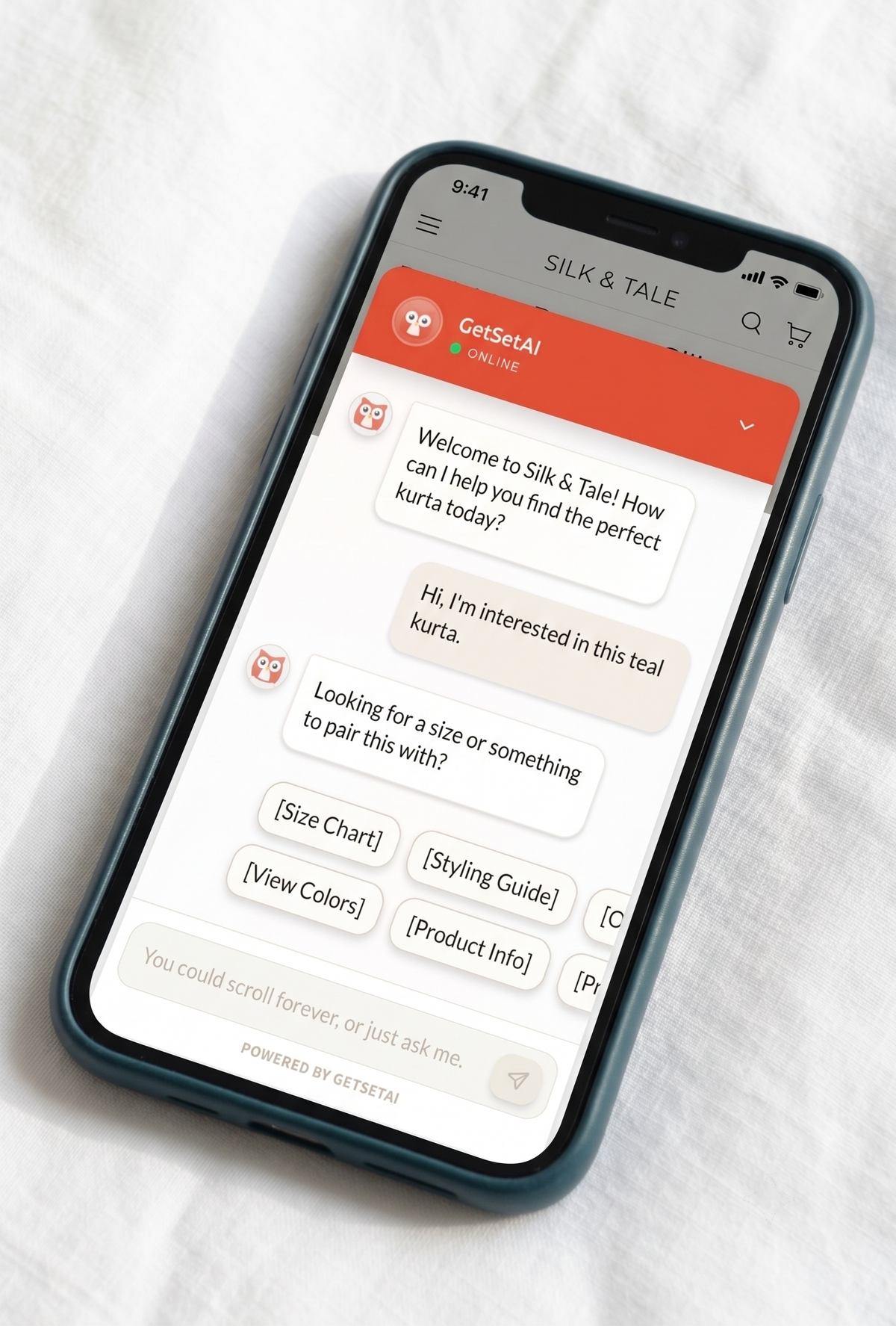
Here's a scenario every fashion brand founder knows, even if they've never thought about it this way.
A shopper lands on one of your product pages. They scroll. They read. They look at the images. They check the price. Their cart already has something in it from earlier. And then — they just stop. They're not adding to cart. They're not bouncing. They're hovering.
That is not browsing. That is hesitation.
A real salesperson would know exactly what to do in that moment. They'd walk over and say something — not a generic "Can I help you?" but something that showed they were paying attention. "You've been looking at the Chanderi silk kurta — should I check if we have it in your size?" or "That one pairs beautifully with the dupatta we have in the new collection."
WisdomChat does exactly this. When the idle signal and cart signal combine, it detects that moment and generates a context-aware opening — pulling from the actual product on the page, the cart content, and the shopper's state.
The message is never generic. It's always specific.
And it has to be, because the window between intent and exit is short. 70% of shoppers who add to cart abandon before checkout. Most stores let that window close without saying a word. That silence is where conversion rate goes to die.
How WisdomChat Personalises for Anonymous Shopify Visitors
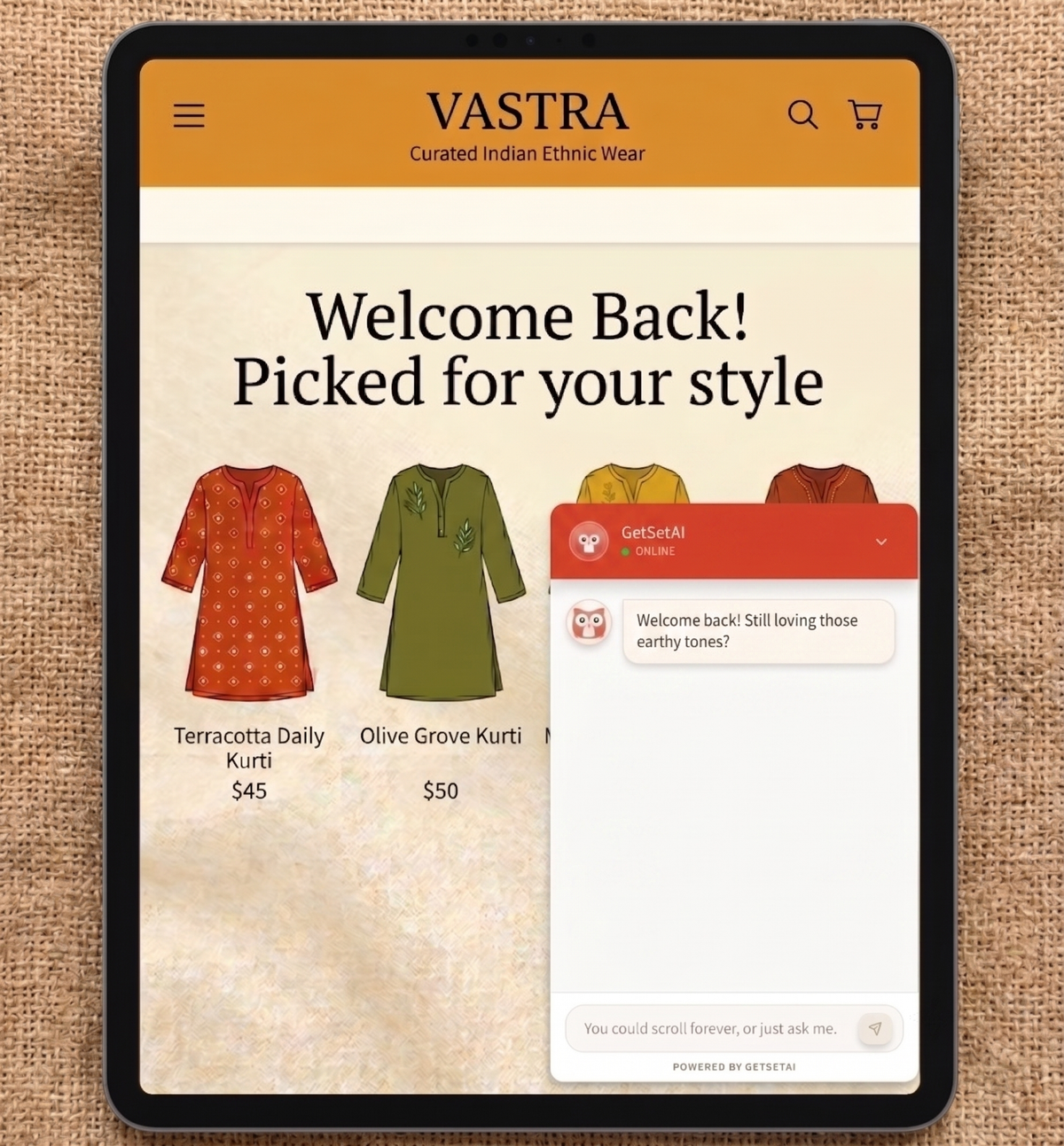
Here's something most people don't think about: 97% of ecommerce visitors browse anonymously — they don't have accounts and have never logged in. But they've been to your store before — maybe multiple times.
Right now, every time they come back, they start from zero. Your store has no idea who they are.
WisdomChat builds a preference profile silently, across sessions, without requiring a login. It tracks the categories a shopper gravitates toward, the colours they keep clicking on, the price range they're comfortable in, the products they've viewed, and what's been sitting in their cart. All without them knowing it's happening. All without asking them to sign up.
So when a returning visitor lands on your store, WisdomChat already knows that this person always browses kurtis in earthy tones and tends to hover around the ₹2,500–₹3,500 range. It uses that to shape the conversation before the shopper says a single word.
This is what personalisation is supposed to feel like. Not "you might also like" banners. Not "based on your browsing." An AI that already knows your taste and just gets to the point.
Lessons from Building an AI Personal Shopper for Shopify Fashion Brands
We've been building this for a while now. Here's what we know that we didn't when we started.
Generic greetings kill conversion.
"Can I help you?" gets ignored. Not because shoppers don't want help — they do. But that message has been trained out of them by a decade of chatbots that say "Can I help you?" and then fail to help at all. A message that references the exact product they're looking at gets a response. Context is everything. AI chatbots that engage contextually convert at up to 4x the rate of passive ones. Every time we made a proactive message more specific, response rate went up.
Discount requests are not price objections.
A shopper who asks "do you have any discount codes?" is in a completely different state of mind than a shopper who's been on the product page for two minutes and keeps scrolling back to the price. Both are "price sensitive" in the abstract. But they need completely different responses — one needs fulfilment, one needs reassurance. We had to build separate systems to handle each. They cannot share the same logic.
The hardest problem wasn't the AI — it was knowing when NOT to trigger.
This took us longer to get right than almost anything else. If a shopper is actively adding something to their cart, interrupting them is worse than saying nothing. The timing of a message matters as much as the message itself. Too early and you're noise. Too late and the moment is gone. Getting this right required understanding not just what the shopper is doing, but what they're about to do.
Support and selling cannot share the same brain.
This is the one we're most certain about. An AI built to handle support — returns, tracking, FAQs — is calibrated to be conservative, neutral, and accurate. That's correct for support. But an AI built to convert needs to be proactive, persuasive, and context-aware. You cannot build one system that does both well. The goals are fundamentally different. We had to architect them separately, and the moment we did, both got better.
Frequently Asked Questions
What is an AI personal shopper for Shopify?
An AI personal shopper for Shopify is a conversational AI that proactively engages shoppers — detecting purchase intent, personalising recommendations, and guiding buyers toward a decision. Unlike standard support chatbots, it is designed to sell, not just answer questions.
How is WisdomChat different from a regular Shopify chatbot?
Regular chatbots wait for questions and respond reactively. WisdomChat detects 8 emotional states in real time, identifies where a shopper is in their decision journey, and triggers context-aware conversations at the right moment — before the shopper asks anything.
Can WisdomChat personalise for visitors who are not logged in?
Yes. WisdomChat builds a preference profile across sessions without requiring a login — tracking browsing patterns, price range behaviour, and product interest. Returning anonymous visitors get personalised experiences without ever creating an account.
Does WisdomChat replace customer support?
No. Support and selling require fundamentally different AI calibration — support needs to be conservative and accurate, while selling needs to be proactive and persuasive. WisdomChat handles the sales layer; your existing support tools handle service queries.
Which Shopify stores benefit most from an AI personal shopper?
Fashion and lifestyle brands with catalogue depth benefit most — especially stores where product choice, sizing, and styling guidance are part of the buying decision. WisdomChat was built specifically for Indian ethnic wear and premium fashion brands on Shopify.
Try WisdomChat
Built for Stores That Are Serious About Converting
WisdomChat is live on Shopify. Self-serve. 5-minute install. If you're running a fashion brand doing serious volume and converting below 4% — this was built for you. Every feature described here is real, live, and working in production stores today. Not a roadmap. Not a demo.
Install in 5 mins